"What the hell happened to Tucker?"
A new biography offers some intriguing clues.

Like many members of the commentariat, I have engaged in idle speculation and conversation over the years about that eternal mystery: “What the hell happened to Tucker?” I’m old enough to remember Tucker Carlson from the 1990s and early 2000s when he got his start at The Weekly Standard and was writing for other prestigious magazines as well. He was smart, funny, observant, and no ideologue. His views seemed to be center-right, and he routinely called out racism, anti-semitism, and nativism. (He was, for example, scathing in denouncing Pat Buchanan.)
Now, all these years later, he is widely seen as one of the most influential purveyors of those noxious nostrums in modern America. He peddles the “great replacement theory,” which claims that “globalist” elites, mostly Jewish, are conspiring to bring black and brown people to America in order to erode the power of white, “legacy” Americans like Tucker Swanson McNear Carlson. He even platforms Holocaust deniers. Little wonder that white supremacists love him.
How did Tucker get from there to here? Essentially the debate boils down to: Is he sincere or opportunistic in promoting bigotry?
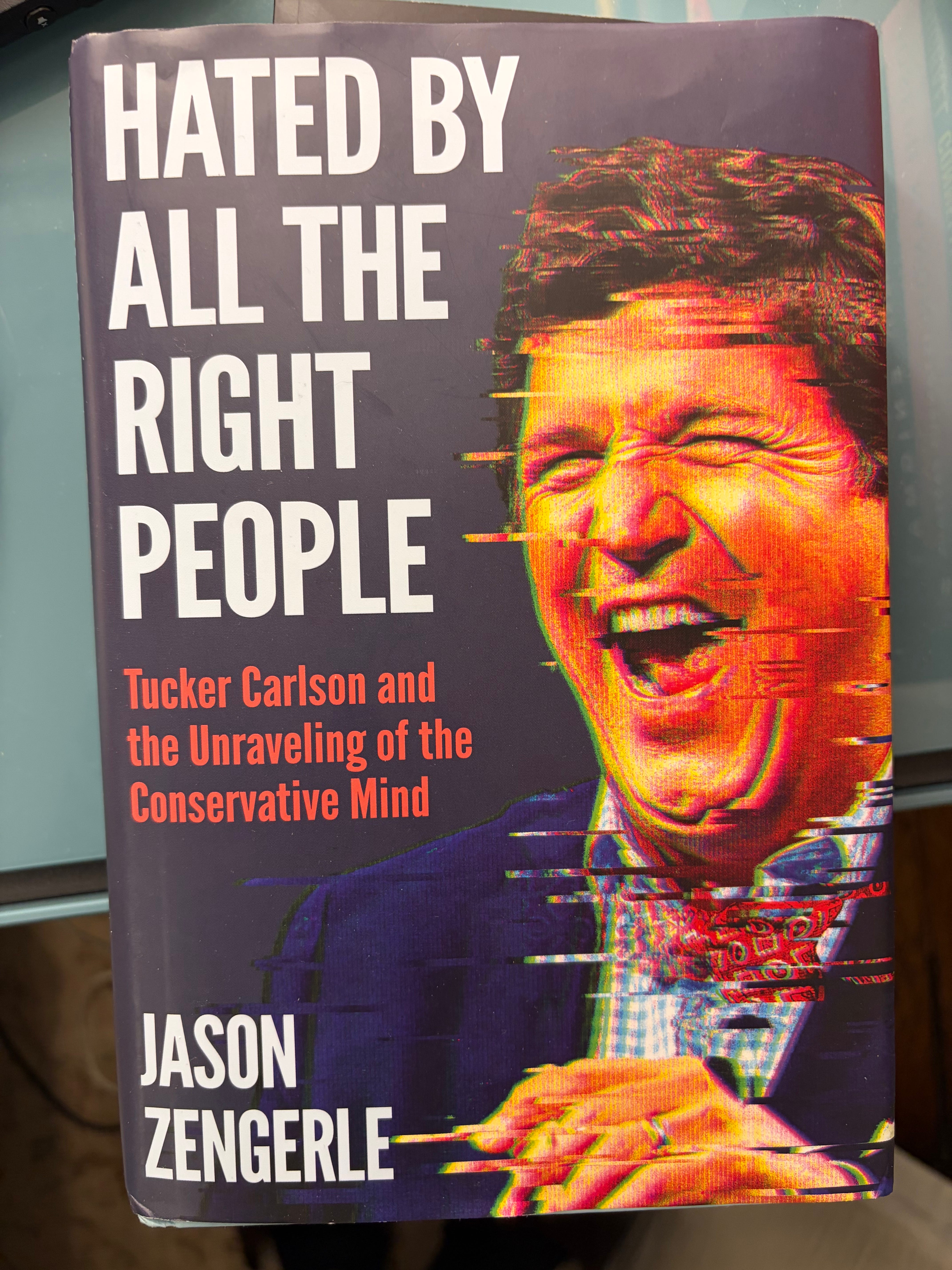
I just read Jason Zengerle’s incisive new biography, “Hated by the All the Right People: Tucker Carlson and the Unraveling of the Conservative Mind.” (I thank my Council on Foreign Relations colleague Stuart Reid, the author of an important book on the assassination of Patrice Lumumba, for recommending it!) I learned a lot about Tucker from Zengerle’s book, including that Tucker was a lazy student who failed to graduate from college (Trinity) and had a habit of substituting insults for reasoned debate even from an early age. I highly commend Zengerle’s book to anyone trying to figure out how the American right—and America itself—reached the sad state it’s in today. Zengerle does not really answer the existential question about Tucker—what happened to him?—perhaps because the mysteries of human character are ultimately unknowable. But he does provide some interesting data points.
There’s nothing wrong with changing your views (I do it regularly!), as long as you are sincerely reacting to new evidence or new events or simply reinterpreting past events or data in a different light. I find it commendable that Tucker disavowed his initial support for the Iraq War; I did so myself, albeit later than Tucker did. But Zengerle also strongly suggests that in other instances Tucker shifted his views for mercenary motives.
For example, when Tucker was the co-host of CNN’s “Crossfire” from 2001 to 2004, he he had to represent the right-wing view whether he believed it or not. So he criticized John McCain (whom he had revered) and sucked up to Tom DeLay (whom he had loathed). Zengerle makes clear that Tucker said a lot of the stuff that he did simply because it was expected of him, and he needed the paycheck.
A similar phenomenon was evident in the evolution of the Daily Caller, the website that Tucker and a friend started in 2010. Its initial purpose was to provide deeply and fairly reported articles from a conservative viewpoint—something that Tucker correctly observed was largely missing from the right-wing media. But Tucker quickly found that in-depth reporting did not generate enough clicks to turn a profit, and he was dismayed that Breitbart—a competing online publication owned by Steve Bannon—was accumulating more readers by being openly racist and nativist. (Breitbart kept writing about “black crime,” for example.) Rather than take the high road, Tucker moved the Daily Caller to the far right in order to compete with Breitbart.
Zengerle also documents that the views Tucker espoused on the air were sometimes at odds with his privately held beliefs: The emails released as a result of Dominion’s defamation lawsuit against Fox showed that Tucker was privately contemptuous of Trump. But on the air he was generally respectful, although he spent much of his time attacking Trump’s critics rather than lavishly praising Trump as some of his Fox colleagues did.
In addition, Zengerle shows that Tucker could engage in bewildering flip-flops: He went from urging Trump to take covid-19 seriously in early 2020 to telling viewers, “The virus just isn’t nearly as deadly as we thought it was, all of us, including on this show.” In fact, it was far more deadly than most people imagined: 1.2 million Americans died of covid, roughly the same number killed in all of America’s wars combined since the dawn of the Republic.
Likewise, Tucker changed his tune about January 6, 2021: Initially, Zengerle writes, Tucker “was unable to hide his anger and despair” at the storming of the Capitol. But before long he was downplaying the attack and espousing the Big Lie, claiming—without a scintilla of evidence—that the assault was an FBI “false flag” operation.
These are bewildering gyrations and difficult to explain. Perhaps only Tucker knows why he changed his tune. It’s hard to know what’s more disturbing: to think that he has gone sincerely loony or that is merely fleecing loonies by saying what they want to hear?
Either way, Tucker managed the rare trick of maintaining his influence and a large audience even after being fired from Fox in 2023. Zengerle writes that Tucker was influential in the selection of J.D. Vance as Trump’s vice president, Tulsi Gabbard as DNI, and Robert F. Kennedy Jr. as secretary of health and human services, while playing a pivotal role in sinking the nomination of Mike Pompeo, Trump’s first-term Secretary of State, to be secretary of defense in his second term. Ironically, Tucker opposed Pompeo because he considered Pompeo to be a “neocon” who would get America into “endless wars” in the Middle East. Tucker, in turn, supported Vance for VP because of Vance’s quasi-isolationist views; Tucker reportedly warned Trump that if he chose Marco Rubio or Doug Burgum as vice president, U.S. intelligence agencies would try to assassinate Trump, because Rubio and Burgum would be more conventional, interventionist Republicans. Wonder how Tucker feels now that the “president of peace” has led America into another war of regime change in the Middle East?
My only complaint with Zengerle’s book is in his depiction of one of my rare encounters with Tucker. In 2017, Tucker invited me on his Fox show to discuss foreign policy—specifically Trump’s soft-on-Russia approach. Zengerle suggests the resulting confrontation “made for good, useful television,” and that it “produced plenty of heat but also a lot of light.”
That’s not how I remember it. As I wrote at the time, “I got the equivalent of a barrel of raw sewage dumped on my head…. I tried to stick to the issues, but he kept interrupting me with smirky sarcasm, obnoxious laughter, and ad hominem insults. It was hard to get in a word edgewise….Ironically, while dishing out a nonstop stream of invective, Carlson kept accusing me of not engaging in substantive debate.”
I tried to give as good as I got; Tucker couldn’t simply run over me as he did with some of the guests he invited on. But it was hardly the Lincoln-Douglas debate. It was, in fact, awful and demeaning—and it’s telling that Zengerle cites that show as one of the highlights of Tucker’s late, unlamented Fox program.
Anyway, that’s a minor cavil with a well-researched, highly readable biography that helps to explicate this moment in American political history—even if it doesn’t really provide a satisfying answer to the “what happened to Tucker?” question. Zengerle writes: “I’m not sure if these questions are answerable—or if the answers are important. Whether Carlson really believes the awful things that he says these days matters less than that he says them at all, and that millions of people—members of Congress, titans of industry, the president, and just everyday Americans—listen to an take their cues from him.”
Thank you Max!
Tucker is a prostitute, not because he likes it but because he likes money. No need to dig for deeper motives.